
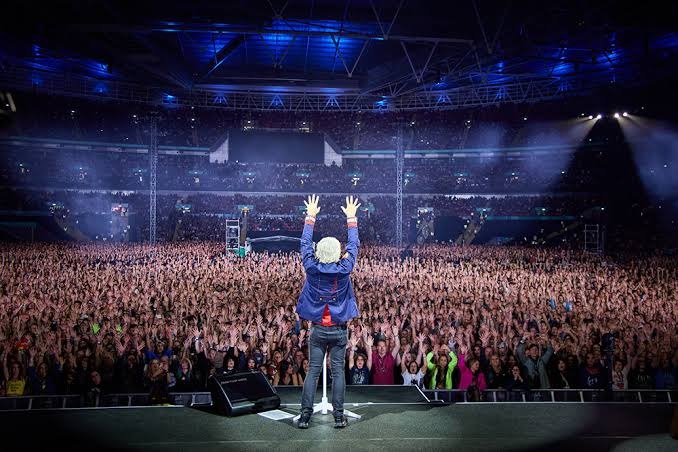
Bon Jovi at Wembley: a triumphant return and 90,000 voices
At a defining moment in Jon Bon Jovi’s recovery, the New Jersey rock veterans delivered an emotionally charged Wembley Stadium performance that celebrated four decades of anthems while confronting the realities of a voice that has been through extraordinary strain.
Prescience Media: Wembley Stadium, London, 4 September 2026
Photo Credit: David Bergman
There are nights when a concert becomes more than a performance. It becomes a reckoning with time, a test of resilience and a reminder of the extraordinary bond between an artist and an audience. Bon Jovi’s return to Wembley Stadium was all three.
For a band whose greatest years produced some of rock’s most enduring anthems, the question hanging over this performance was not whether the songs would still resonate. Their place in the popular imagination is secure. The question was whether Jon Bon Jovi, after a prolonged and deeply personal battle to recover his singing voice, could reclaim the stage on his own terms.
The answer was complicated, moving and, ultimately, uplifting.
In 2022, the frontman discovered that one of his vocal cords was atrophying. Major surgery and extensive rehabilitation followed, forcing him to confront the possibility that the instrument at the centre of his career might never fully recover. The band’s 2019 Wembley appearance had already raised concerns about his voice, but the extent of the damage became clearer through the documentary series Thank You, Goodnight.
This return, therefore, carried a weight rarely felt at a stadium concert. For the first of three Wembley shows on the current run, Bon Jovi were not simply revisiting their past. They were testing the possibilities of their future.
The opening offered an immediate departure from convention. Rather than charging into a familiar stadium rocker, the band began with a cover of The Beatles’ With a Little Help from My Friends. Its message was unmistakable. Support, solidarity and the strength of collective voices would be central to the evening.
Jon’s vocal was carefully supported by the band’s harmonies and arrangements, allowing him to approach the material without being left unnecessarily exposed. It was a thoughtful introduction to a performance shaped as much by musical judgement as by ambition.
James Bay had warmed up the crowd with an accomplished opening set, bringing a distinctive blend of soul, alternative rock and melodic guitar work to the vast venue. His performance was marked by clarity and energy, with Hold Back the River providing a particularly effective reminder of his ability to command a large audience.
Once Bon Jovi took over, the early stages favoured more recent material. Beautiful Drug, We Weren’t Born to Follow and Lost Highway established the rhythm, although the latter missed some of the instrumental character that made the original recording distinctive. The band were clearly determined to present a show that acknowledged their later catalogue rather than relying exclusively on past glories.
But Wembley had come for the songs that had defined generations.
When Jon recalled 1986, the crowd needed little prompting. The opening of You Give Love a Bad Name unleashed an enormous collective singalong, with tens of thousands of fans supplying the vocal force that has always made Bon Jovi’s music so effective in a stadium.
The distinction was important. Jon did not sound as he had at the height of the band’s commercial dominance, and there were moments when the physical concentration required to deliver the songs was evident. His expressions tightened, his grip on the microphone stand became more pronounced, and the limits of his recovered voice were sometimes impossible to ignore.
Yet the audience did not respond with disappointment. It responded with participation.
On Born to Be My Baby, It’s My Life and, eventually, Livin’ on a Prayer, Wembley became an immense communal chorus. The latter arrived before the encore, its familiar introduction drawing an almost instantaneous reaction. The crowd took over so completely that any technical assessment of Jon’s vocal performance became secondary to the sheer force of the moment.
That was the evening’s defining achievement. The audience was not merely singing along to the soundtrack of its youth. It was helping to carry a performer through some of the most demanding passages of his career.
The emotional intensity deepened with Bed of Roses. Under a sea of illuminated mobile phones, the ballad exposed the vulnerability at the heart of the performance. In These Arms posed a more formidable vocal challenge, and the close ups on the giant screens made clear how deliberately Jon was working through each phrase.
There was something uncomfortable about watching an artist concentrate so intensely on an act that once appeared instinctive. But there was also something profoundly human about it. This was not the effortless swagger of the late eighties, nor an attempt to recreate a past that cannot be recovered. It was a musician rebuilding his relationship with his craft in front of the people who had followed him for decades.
The inclusion of These Days, introduced with a recollection of the band’s earlier Wembley appearances, offered a different kind of reward. Its more reflective character provided a welcome counterpoint to the stadium staples, reminding listeners that Bon Jovi’s legacy extends beyond the hits. For longtime followers, it was among the evening’s most satisfying selections.
The band’s musicianship remained robust throughout. Drummer Tico Torres was a quietly commanding presence, providing the precision and drive that kept the performance grounded. Keyboardist David Bryan brought colour and authority to the arrangements, particularly during I’ll Sleep When I’m Dead and the extended closing section of Keep the Faith. Guitarist Phil X supplied a harder edge, while producer and guitarist John Shanks contributed to the broader sound.
The absence of former guitarist Richie Sambora was still felt. His melodic instincts and distinctive musical partnership with Jon were integral to Bon Jovi’s classic sound, and no replacement can entirely reproduce that chemistry. Nevertheless, the band avoided allowing the evening to become a study in what was missing. The emphasis remained on what could still be delivered.
There were occasional compromises. Some later songs felt less distinctive beside the classics, and Jon’s voice was not consistently equal to the demands of the material. Bad Medicine, for instance, benefited from the crowd’s enthusiasm and a contribution from percussionist and backing vocalist Everett Bradley, whose stronger vocal delivery helped carry part of the performance.
But the concert’s emotional arc mattered more than individual imperfections.
As the set gathered momentum, Raise Your Hands, Keep the Faith and Wanted Dead or Alive demonstrated the enduring strength of Bon Jovi’s songwriting when matched with a receptive audience. The encores were particularly effective, with I’ll Be There for You prompting another mass singalong before Always brought the evening to its emotional conclusion.
The final ballad was not an immaculate vocal showcase. It did not need to be. Jon’s concentration was again visible, and as the song ended, he appeared overcome by the response. After more than two and a half hours on stage, the moment felt less like a conventional finale than an acknowledgement of everything required to get there.
Bon Jovi have spent decades building a catalogue designed for collective release: songs about love, defiance, ambition and survival, written to be shouted across arenas and stadiums. At Wembley, those qualities took on a different significance. The audience was not simply celebrating the band’s history. It was affirming the possibility of a new chapter.
There were shortcomings, and it would be disingenuous to pretend that Jon’s voice has returned unchanged. The performance made clear that recovery remains a process rather than a completed story. Nor can nostalgia alone guarantee the band’s future.
What Wembley demonstrated, however, was that a great live act is not defined solely by technical perfection. It is also measured by judgement, musicianship, courage and the ability to make a moment matter.
For Bon Jovi, this was not a return to the late eighties. It was something more personal: a hard won return to the stage, undertaken without disguising the struggle that made it possible.
And when 90,000 voices rose to meet Jon Bon Jovi on Always, the message was unmistakable. He may have had to learn to sing again, but he never had to earn his audience’s affection twice.
Post a comment