
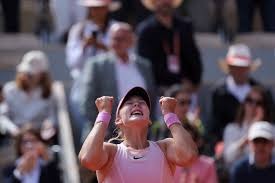
Andreeva Holds Nerve to Clinch First Grand Slam Title at Roland Garros
Paris- For a brief spell midway through the opening set, it felt as though Mirra Andreeva’s debut Grand Slam final might be slipping from her grasp before it had truly begun.
On a blustery Court Philippe-Chatrier, where the wind dictated tempo and hesitation was punished, the 19-year-old appeared tight, reactive and weighed down by the magnitude of the moment. Her opponent, qualifier Maja Chwalińska, added further complication, refusing to offer rhythm and instead constructing a match designed entirely around disruption.
But what unfolded over the next hour was a demonstration of composure and rapid learning well beyond Andreeva’s years.
The Russian regrouped after a shaky start and gradually imposed order on chaos, recovering from early inconsistencies to secure a 6–3, 6–2 victory and with it her first French Open title.
It is a result that confirms what has been apparent since she arrived on tour at just 15 years old: elite success was always a question of timing rather than possibility. That timeline has now accelerated sharply.
At 19, Andreeva becomes the youngest Roland Garros champion since Monica Seles in the early 1990s, and one of the youngest major winners of the modern era. Yet the manner of her victory may be as significant as the milestone itself.
After sealing championship point with a composed backhand winner, she collapsed to the clay in relief before immediately turning to embrace her team and family. In her on-court speech, she paid tribute to coach Conchita Martínez, the former Wimbledon champion who has helped refine both her tactical discipline and emotional control.
She also highlighted the influence of sports psychologist Alexis Castorri, crediting him with reshaping her mental approach. “You can always choose how you’re going to be on the court,” Andreeva said. “I just decided to choose to be a fighter.”
That shift in mindset was visible throughout a final that initially threatened to drift away from her.
Chwalińska, the second qualifier in history to reach a Grand Slam final in the Open era, played with variety and intelligence, mixing heavy topspin, sliced backhands and sharp angles to break up Andreeva’s rhythm. In difficult, slow conditions, she succeeded early in dragging the match into discomfort rather than clean exchanges.
Andreeva, unsettled and hesitant, briefly reverted to passive patterns, overusing high, looping shots and struggling to find timing on her forehand. At one stage, uncertainty crept into decision making as she sought safety over control.
The turning point arrived at 2–3 in the opening set. Having steadied her serve after a scrappy start, Andreeva began stepping inside the baseline, taking the ball earlier and redirecting rallies with growing authority. Once she imposed tempo, the gap in firepower and structure became clear.
From that moment, she won nine consecutive games, dismantling Chwalińska’s resistance and effectively closing the contest before it could re-open.
The victory also reflects a growing maturity off the court. Andreeva referenced drawing inspiration from Roger Federer, particularly his composure in high-pressure moments, and spoke of consciously trying to maintain emotional balance during matches.
“I watched a lot of Roger’s matches here,” she said. “I really wanted to behave in a similar way, not be frustrated, and just stay calm.”
For Chwalińska, the defeat ends a remarkable fortnight in which she defied expectations to reach her first major final, but the physical and emotional toll of the run ultimately told against a fresher, more complete opponent.
For Andreeva, however, this was the moment promise became proof. A first Grand Slam title delivered not through perfection, but through adjustment, control and an increasingly rare ability to solve problems under pressure.
Post a comment